
Accidental loss watch insurance can help if your watch goes missing due to a real-world mishap—but many policies treat “lost” items differently than theft or damage. Here’s what accidental loss typically means, what’s covered, and the common reasons claims get denied.
• Learn what “accidental loss” means in watch insurance
• Understand when claims are approved or denied
• Choose coverage that protects you from everyday mistakes
Table of Contents
Accidental loss watch insurance
Accidental loss is one of the most anxiety‑inducing scenarios for watch collectors. There’s no theft, no damage—your watch is simply gone. It slipped off, was left behind, or vanished during normal daily activity.
Many collectors assume insurance will step in automatically. In reality, whether you’re covered depends entirely on the type of policy you have.
Overview
Accidental loss is often confused with theft or damage, but insurers treat it differently. Homeowners insurance usually excludes it entirely, while specialized luxury watch insurance often includes it under all‑risk coverage.
Knowing the difference before a loss occurs is critical.
Question: Does watch insurance cover accidental loss?
Answer: Yes, luxury watch insurance typically covers accidental loss when the policy includes all‑risk coverage. Standard homeowners insurance usually excludes accidental loss entirely.
Why Homeowners Insurance Usually Denies Accidental Loss
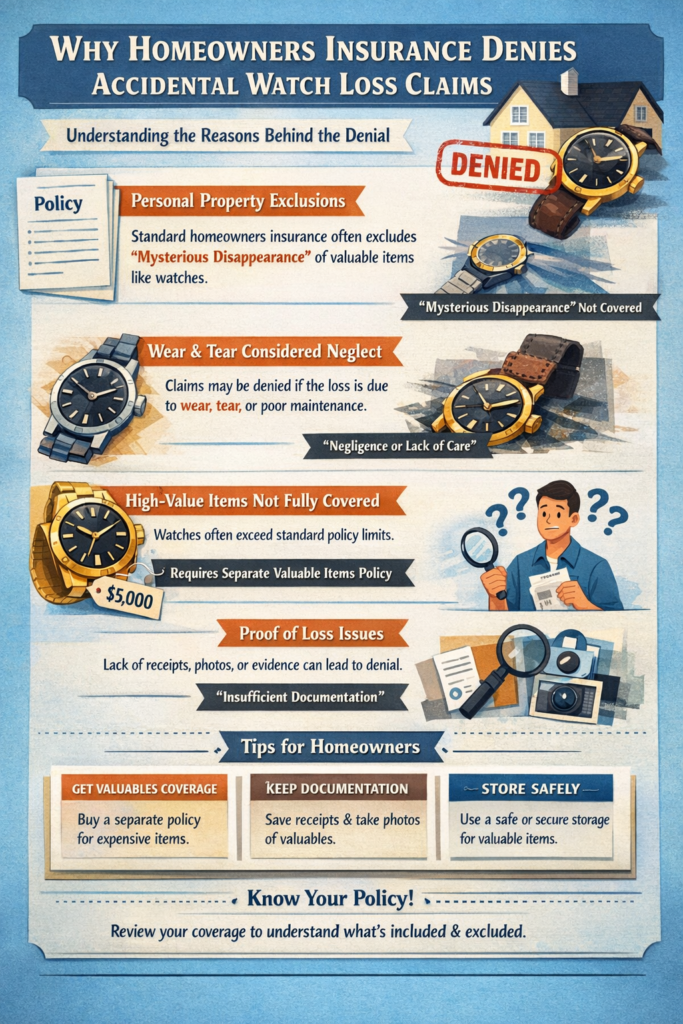
Homeowners policies are built around “named perils.” If you can’t point to a specific event—like a break‑in or fire—the claim is often denied.
Common denied scenarios: • Watch slipping off unnoticed
• Leaving a watch behind in public
• Losing it during travel or daily wear
That’s why luxury watch insurance exists, to cover real‑world situations homeowners policies ignore.
What Counts as Accidental Loss Under Specialty Policies
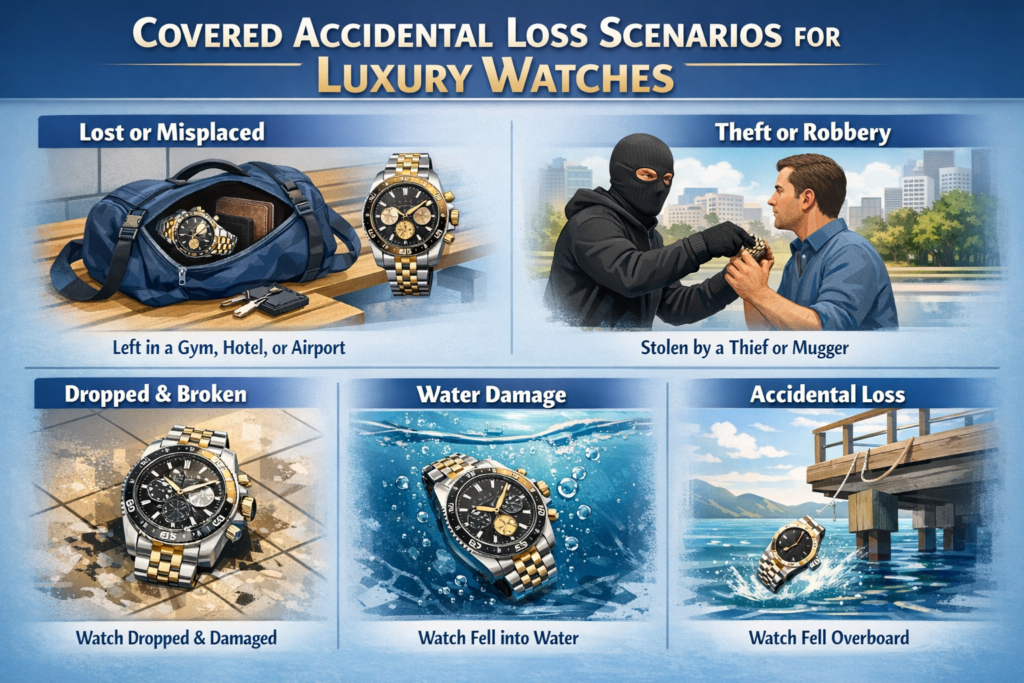
Specialty watch insurance often covers: • Accidental loss during daily wear
• Loss while traveling
• Loss when the watch was temporarily removed
• Unexplained disappearance without theft
This is sometimes labeled as mysterious disappearance, which is closely related.
If you want a deeper explanation, see What Is Mysterious Disappearance in Watch Insurance?.
Compare insurance policies that explicitly include Accidental loss watch insurance and mysterious disappearance coverage.
When Accidental Loss Is Not Covered
Even specialty policies have limits.
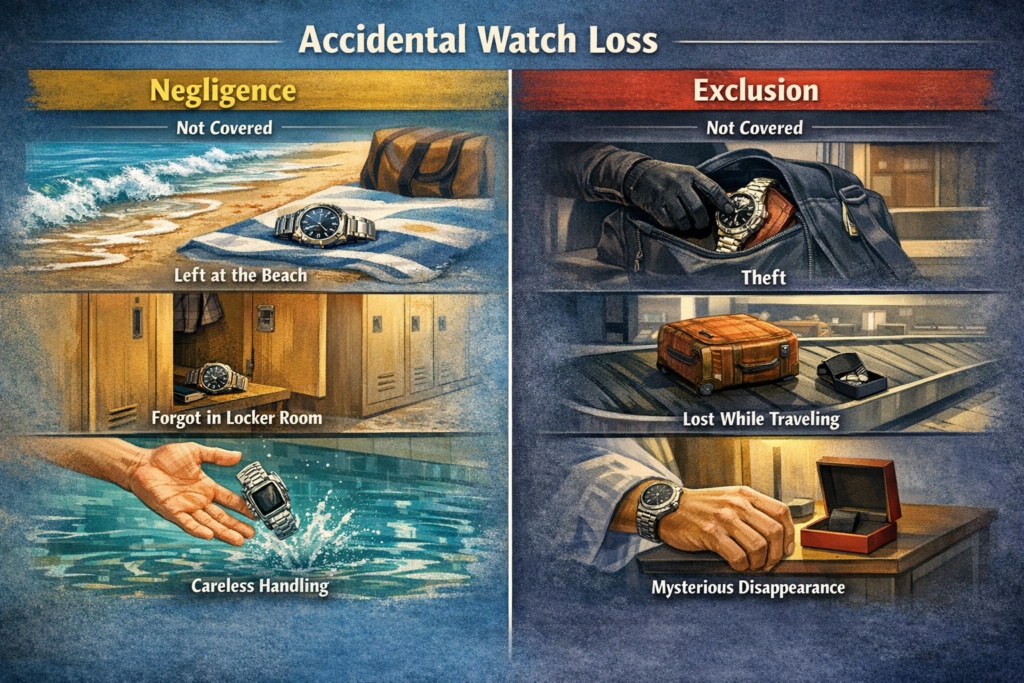
Coverage may be denied if: • Loss resulted from gross negligence
• Policy exclusions apply (e.g., unsecured storage)
• Documentation is missing
Reading exclusions carefully matters as much as understanding coverage.
How Insurers Evaluate Accidental Loss Claims
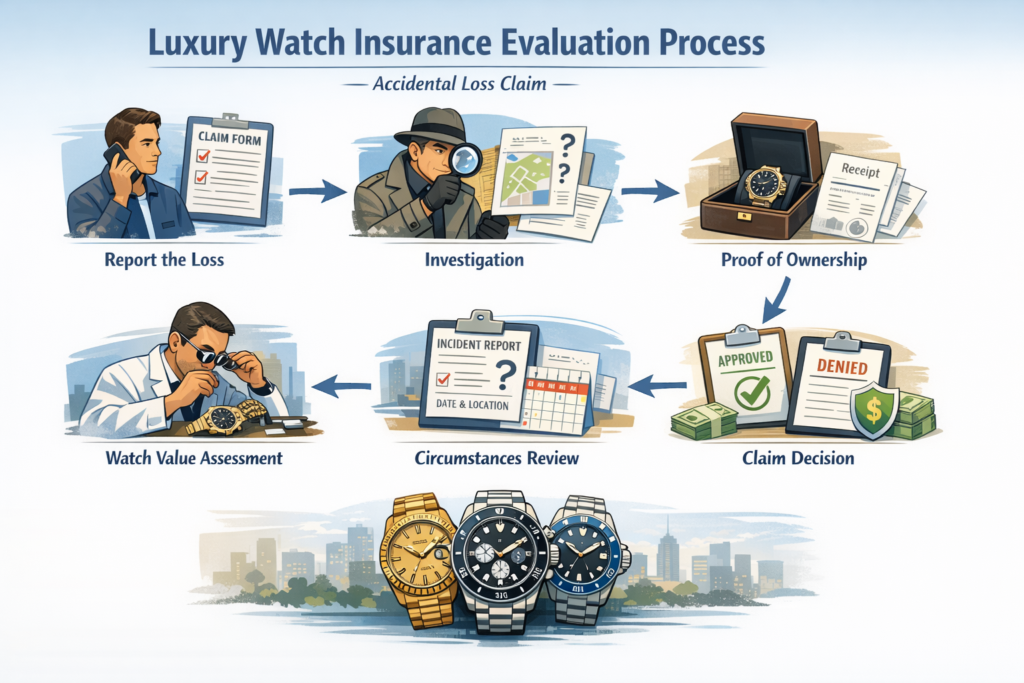
Insurers typically assess: • Last known possession
• Ownership documentation
• Appraisals and photos
• Claim timeline and consistency
According to U.S. insurance regulators, high‑value personal items often require separate scheduled coverage beyond standard homeowners policies.
For documentation prep, review How to Appraise Your Watch for an Insurance Policy.
Choosing Coverage That Protects Against Accidental Loss
🕐 Home Watch Insurance Coverage Gap Checker
See how much of your watch’s value may be uninsured if it’s accidentally lost.
Your Coverage Analysis
Recommendation
Your homeowners insurance may only cover $1,500 of your $15,000 watch, leaving you with $13,500 at risk if your watch is lost or stolen.
Consider specialty watch insurance to:
- Cover the full value of your watch without sub-limits
- Protect against accidental loss, theft, and damage
- Enjoy lower deductibles (often $0) compared to homeowners policies
- Get coverage for mysterious disappearance
- Pay affordable premiums (typically 1-2% of watch value annually)
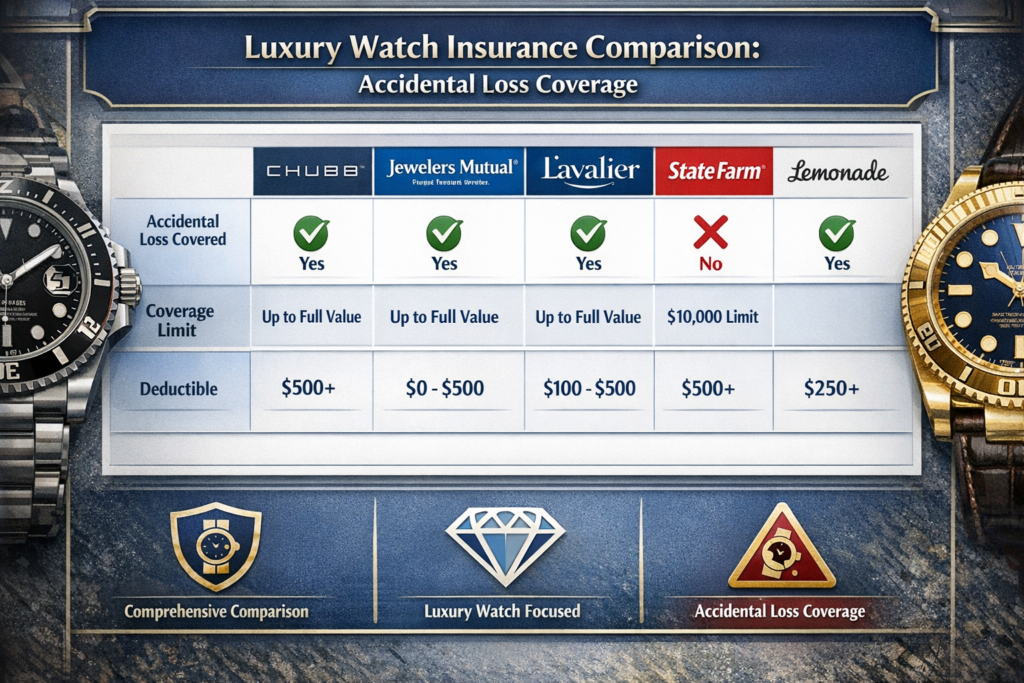
When comparing insurers, confirm: • All‑risk wording
• Accidental loss included
• Worldwide coverage
• Agreed value payouts
To benchmark options, review best luxury watch insurance options and comparisons like BriteCo vs WAX Insurance.
Get quotes from insurers that protect against accidental loss—not just theft or damage.
Quick Checklist: Avoiding Accidental Loss Denials
• Keep appraisals updated
• Photograph your watches regularly
• Document travel and wear habits
• Store watches securely when not worn
Key Takeaways
Accidental loss is one of the most common ways collectors lose watches.
Homeowners insurance almost always excludes it.
Luxury watch insurance with all‑risk coverage protects against accidental loss.
Protect your collection with insurance that covers how watches are actually lost.
Next Read
• Best Luxury Watch Insurance in 2026
• Is Homeowners Insurance Enough for a $10,000 Watch?