

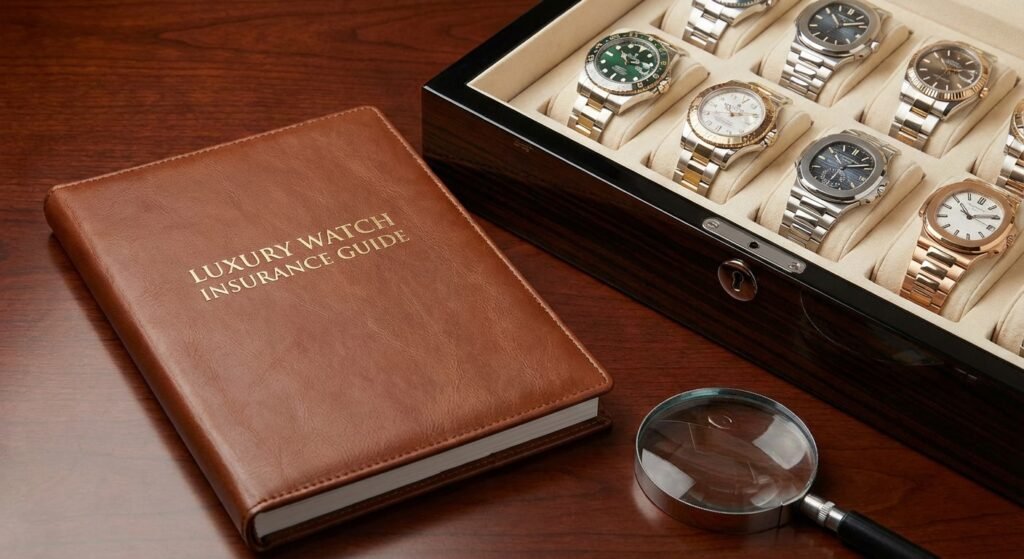
I’ve been around luxury watches long enough to know that the real anxiety doesn’t come from wearing a $50,000 Audemars Piguet to dinner. The sick feeling hits when you realize your Daytona isn’t on your wrist anymore, or when you see a massive scratch across the sapphire crystal of your newly acquired Nautilus.
Here’s what most people don’t understand: insurance works completely differently than watch collectors assume. You can own a $200,000 collection and still be completely, utterly unprotected. I’ve watched it happen more times than I care to count.
A friend of mine lost three Rolex pieces in a home burglary and uncovered his homeowners policy maxed out at $2,500 for all jewelry combined. He recovered less than 5% of his actual loss. The insurance company wasn’t being difficult or unfair.
They paid exactly what the policy stated. He simply never bothered to read what he was actually covered for.
The protection you receive from your insurance policy depends on dozens of factors working together. The policy type you choose, the coverage limits you establish, the appraisals you maintain, and especially the exclusions buried in the fine print all mix to create vastly different outcomes.
Two collectors can pay similar premiums and receive completely different levels of actual protection when something goes wrong.
Understanding these details separates sleeping soundly from lying awake worrying about six-figure losses you have no way to recover.
The Foundation: What Actually Protects Your Watches
Watch Insurance Premium Calculator
Calculate estimated insurance premiums for your luxury timepiece. Get instant quotes comparing standard homeowners coverage versus specialized watch insurance with custom protection options.
Most people approach luxury watch insurance completely backward. They buy the watch first, enjoy it for several months, and then almost as an afterthought start thinking about protection.
By that point, they’ve already worn it traveling internationally, left it in hotel safes, and accumulated months of exposure to theft or damage without proper coverage.
The better approach starts before you even purchase a significant timepiece. You need to understand exactly how insurance will protect it, what gaps exist in your current coverage, and what the true cost of protection will be annually.
This completely changes how you think about acquisitions.
Most collectors focus exclusively on the premium when evaluating insurance policies. But the premium functions as nothing more than the entry fee.
The structure beneath it decides whether you’re actually protected or just paying for the illusion of security.
Coverage basis represents the foundation everything else builds on. Agreed value coverage means the insurer and you establish the watch’s value upfront, and that’s exactly what they pay in a total loss.
No arguments, no depreciation, no disputes about current market conditions.
The number you agreed on is the number you receive.
Replacement value coverage means the insurer pays what it costs to replace your watch with something of “like kind and quality” at the time of loss. This sounds perfectly reasonable until you realize that a discontinued Patek Philippe reference has no true replacement.
The insurer might offer you a current production model that bears little resemblance to what you actually lost.
I’ve worked with collectors who opted for replacement value coverage on vintage pieces, thinking it was perfectly adequate. When a 1960s Rolex Daytona was stolen, the insurer offered them a modern Daytona.
They completely missed the point that the vintage reference had appreciated dramatically and represented something irreplaceable from a collecting standpoint.
The owner ended up in a nine-month dispute that eventually settled for far less than the watch’s actual market value.
Coverage territory matters far more than most people realize. Your watch doesn’t just sit in your safe at home.
It travels with you on business trips, vacations, and daily errands.
Domestic-only policies leave you completely exposed the moment you cross international borders.
I learned this the hard way when a colleague had his Vacheron Constantin stolen in Paris, only to explore his policy specifically excluded coverage outside North America. The watch was gone, and he had zero recourse.
Worldwide coverage costs marginally more but eliminates this gap entirely.
Deductible structure dramatically affects your actual protection. A $5,000 deductible on a $25,000 watch means you’re self-insuring 20% of the value.
For collectors with multiple pieces, per-item deductibles create situations where you’re paying substantial out-of-pocket costs on every single claim.
The best policies offer zero-deductible coverage, meaning you receive full payment without any personal contribution when loss occurs.
Covered perils reveal where most policies completely fail collectors. Standard homeowners policies typically cover named perils, which means specific listed events like fire, theft, and certain types of water damage.
Mysterious disappearance, when your watch simply vanishes without clear explanation, gets routinely excluded. Yet this represents one of the most common loss scenarios for watches.
You take it off to wash your hands at a restaurant, get distracted by a conversation, and realize an hour later it’s gone. Was it stolen?
Did you leave it somewhere?
You genuinely don’t know. Without mysterious disappearance coverage, you’re not getting paid regardless of what actually happened.
The Appraisal Game Nobody Explains Properly
Here’s something that really frustrates me about how the insurance industry operates around luxury watches: the appraisal system is designed to create gaps in coverage, and most collectors don’t even realize they’re playing a rigged game.
Insurance companies require appraisals for underwriting purposes to establish the watch’s value for coverage. But here’s what they conveniently avoid emphasizing: appraisals quickly become obsolete in a dynamic market, and maintaining current valuations falls entirely on your shoulders.
If you fail to update your appraisal as the market moves, you’re automatically underinsured, and the insurer faces zero consequences for this gap.
Think about what happened to Rolex sports models between 2019 and 2021. A Submariner Date reference 116610LN that sold for about $9,000 retail suddenly commanded $15,000 to $18,000 on the secondary market.
Owners who obtained appraisals in 2019 showing $9,000 valuations and never updated them were suddenly underinsured by 60% to 100%.
When theft occurred, they recovered $9,000 while the replacement cost was $18,000. The insurance company paid exactly what the appraisal stated, leaving the collector to cover the difference out of pocket.
The sophisticated approach involves strategic appraisal timing. Rather than getting appraisals only when insurers demand them, you proactively schedule reappraisals whenever significant market movements occur.
This doesn’t mean constantly chasing every minor price fluctuation, but it does mean paying attention to your collection’s specific segment.
I track appraisal timing using a straightforward system: major reappraisal every three years automatically, plus event-driven reappraisals when specific triggers occur. Those triggers include discontinuation of your reference by the manufacturer, which typically drives immediate appreciation.
Significant currency movements matter if your watches are denominated in foreign currencies.
Major auction results for comparable pieces signal market shifts. Any substantial modification or restoration you’ve completed changes the value equation.
The cost of reappraisals typically runs $150 to $400 per watch, which is absolutely minuscule compared to the coverage gaps that develop without them. And here’s a strategy most collectors completely miss: maintain relationships with two different appraisers.
Use them alternately, and occasionally get dual appraisals on your most valuable pieces.
This provides validation of valuations and prevents situations where a single appraiser’s methodology disadvantages you.
Appraisal selection matters far more than the surface-level credential checking most people do. Yes, you want certified appraisers with recognized credentials.
But more importantly, you want appraisers who actively track the secondary market for the specific brands and references you collect.
An appraiser who specializes in vintage Omega won’t necessarily understand current Patek Philippe market dynamics. Segment expertise dramatically affects valuation accuracy in ways that generic watch knowledge can’t copy.
Documentation quality separates amateur appraisals from professional ones. Your appraisal should include extensive photography showing the watch from multiple angles, close-ups of the movement if the case back is transparent, detailed condition notes documenting any imperfections or service marks, explicit identification of all original components versus replacements, and most importantly, clear methodology explaining how the appraised value was determined.
Generic appraisals that simply state “Fair Market Value: $35,000” without supporting analysis create massive problems during claims. Insurers challenge these valuations, demanding detailed justification you may not be able to provide months or years later.
Comprehensive appraisals that reference recent auction results, dealer asking prices, and market trend analysis provide the documentation insurers need to process claims smoothly without extended disputes.
The Appraisal Game Nobody Explains Properly
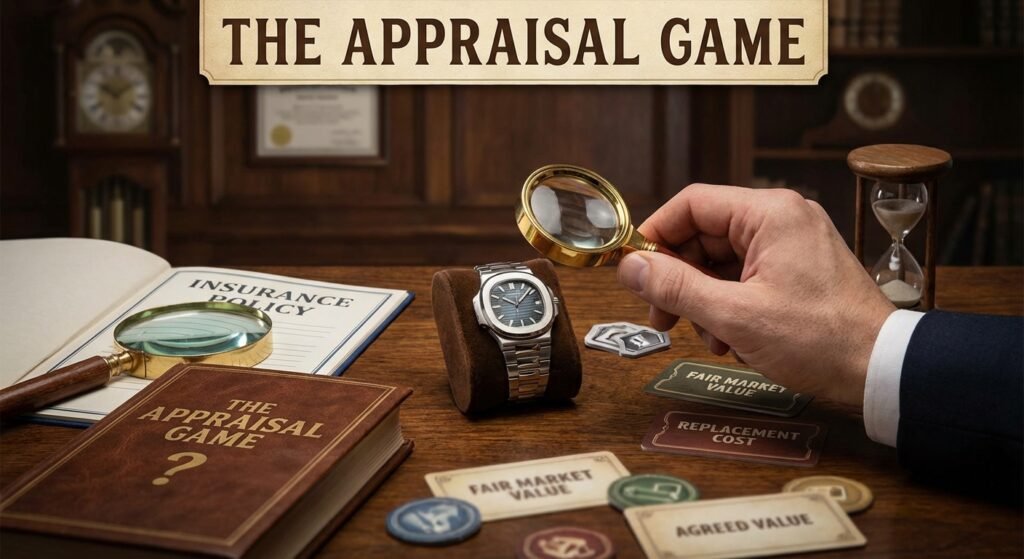
Once you understand the foundational elements, building comprehensive protection becomes a systematic process rather than a confusing insurance shopping nightmare. I approach this the same way I approach building a watch collection, with clear goals, careful selection, and attention to how person pieces work together.
Layer one involves maximizing whatever coverage your homeowners or renters policy already provides. Most policies include some jewelry coverage within the base policy, typically $1,500 to $5,000.
While completely inadequate for serious pieces, this provides automatic protection for your less valuable watches without extra cost.
Understand these limits precisely, and use them strategically for watches that fall within the coverage amount.
Layer two adds scheduled personal property coverage to your homeowners policy. This allows you to specifically list person watches with their appraised values, extending coverage beyond the base policy limits.
This works reasonably well for collections valued up to about $50,000 total, and costs roughly 1% to 2% of the scheduled value annually.
The advantage here is simplicity. You’re dealing with your existing insurance carrier, and the premium gets bundled into your homeowners bill.
But here’s where it gets tricky: scheduled property on your homeowners policy stays subject to your homeowners policy terms and exclusions.
If your base policy excludes mysterious disappearance, that exclusion typically extends to your scheduled property. And most importantly, any claims against your scheduled property become claims against your homeowners policy, potentially affecting your rates and insurability for your home itself.
Layer three implements standalone specialized watch insurance through carriers like Jewelers Mutual, BriteCo, or Chubb’s high-value collections division. This is where serious protection actually begins.
Standalone policies offer all-risk coverage, meaning everything is covered except specifically excluded perils, as opposed to only named perils being covered. This inverts the coverage presumption completely in your favor. These policies typically include zero deductibles, worldwide coverage with no geographic exclusions, mysterious disappearance coverage as standard, agreed value settlements with no depreciation, and claims that don’t affect your homeowners insurance in any way.
The premium runs slightly higher than scheduled property add-ons, about 1% to 2.5% of appraised value, but the coverage quality improves dramatically. You’re actually protected rather than just technically insured.
I run a hybrid approach for my own collection. Lower-value pieces under $10,000 get covered through scheduled property on my homeowners policy.
Significant pieces above $10,000 and anything rare or discontinued gets standalone specialized coverage.
This optimizes cost while ensuring my most important pieces receive protection I can actually rely on when something goes wrong.
Layer four adds specialized riders for specific risk scenarios. If you regularly travel internationally with watches, dedicated travel insurance riders extend coverage during transit and provide emergency support services.
If you attend watch collector events or exhibitions where your pieces get displayed, exhibition coverage protects against venue-specific risks.
If you lend watches to family members or occasionally consign pieces for sale, temporary transfer riders maintain protection during those periods.
The coverage architecture for a serious collection ends up looking less like a single insurance policy and more like a carefully constructed protection framework with different elements addressing different exposure scenarios. This complexity bothers some collectors, but it’s really just the natural result of insuring assets that don’t behave like typical personal property.
What Actually Happens When You File a Claim
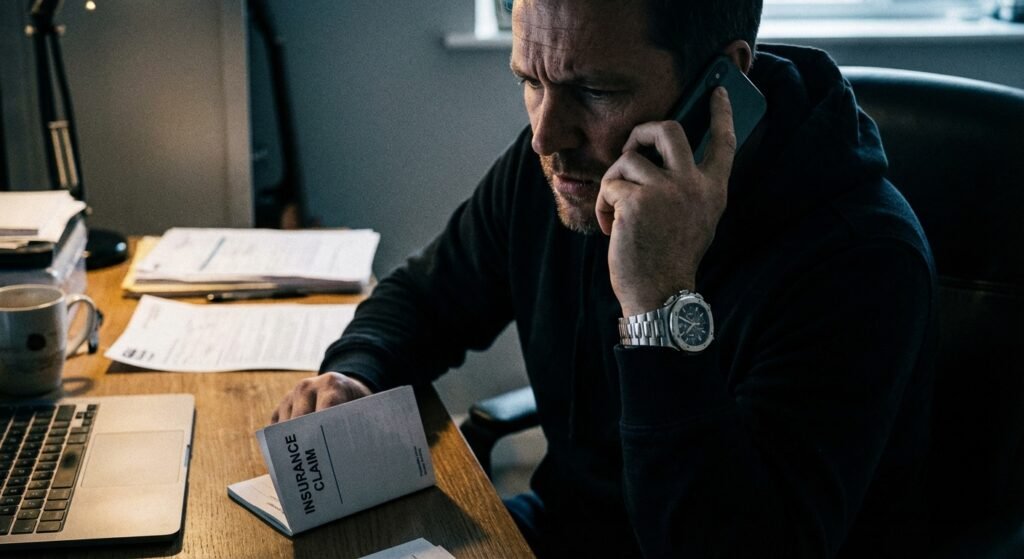
Here’s something that always surprises me: collectors will spend hours researching which specific insurance policy to purchase, comparing premiums down to the dollar, but almost never investigate what the claims process actually looks like. Then when loss occurs, they’re completely shocked by requirements they didn’t anticipate and delays they don’t understand.
I’ve been through three significant watch insurance claims over the years. One theft, one accidental damage, and one mysterious disappearance.
Each taught me something absolutely vital about how the process actually works versus how insurers describe it in their marketing materials.
Immediate response decides everything that follows. The moment you explore loss or damage, you need to do three things simultaneously: secure any remaining evidence, file a police report if theft or loss occurred, and contact your insurer within 24 hours to start the claim.
Here’s what nobody tells you upfront: insurers track the time gap between when loss occurred and when you reported it. Extended delays, like discovering your watch is missing and waiting a week to report it, raise immediate red flags that can complicate or even jeopardize your entire claim.
The insurer starts questioning whether you’re certain about when and where the loss happened, and your credibility suffers from the very beginning.
I learned this during my mysterious disappearance claim. My watch vanished somewhere between my office and home.
I genuinely didn’t know where.
I realized it was missing around 9 PM and immediately filed a police report and contacted my insurer by 10 PM the same evening. The claims adjuster later told me that immediate reporting significantly streamlined the investigation because it demonstrated I wasn’t manufacturing a convenient loss narrative after the fact.
Documentation submission separates smooth claims from absolute nightmare scenarios. Within 48 to 72 hours of your initial claim filing, the insurer will request comprehensive documentation: your original appraisal, proof of ownership like your purchase receipt, photographs of the watch, the police report, a written statement describing exactly what happened, and any relevant service or repair records.
Collectors who maintain organized documentation files send everything within days and move their claims forward rapidly. Those who need to hunt through years of email archives and closet boxes spend weeks assembling documentation, during which the claim stalls completely.
Every day of delay adds more questions and more skepticism from the insurer’s perspective.
I maintain a cloud-based folder for each watch containing every relevant document, and I update it immediately after any service or appraisal. When my theft claim occurred, I submitted complete documentation within six hours of filing.
The claim settled in three weeks.
Investigation and assessment comes next, and this is where claims either proceed smoothly or deteriorate into extended disputes. For theft claims, insurers verify the police report and may interview you about the circumstances.
For damage claims, they typically require assessment by an authorized service center to decide whether the damage is covered and what repair costs will actually be.
For mysterious disappearance, they investigate to confirm you didn’t actually gift, sell, or pawn the watch.
The investigation intensity scales directly with the claim value. A $5,000 claim gets relatively minimal scrutiny.
A $50,000 claim triggers comprehensive investigation including database checks to verify you haven’t filed multiple suspicious claims with different insurers over the years.
I’ve heard stories of collectors having their social media profiles examined during large claims investigations. Insurers look for evidence you still possess the supposedly lost watch or for patterns suggesting potentially fraudulent behavior.
This is exactly why maintaining absolute honesty and accuracy throughout the process is completely non-negotiable.
Any inconsistencies in your statements, even minor ones like misremembering exactly what time you noticed the watch was missing, become problems that delay or jeopardize your entire claim.
Settlement negotiation represents the final stage, and it’s often where collectors leave substantial money on the table. Once the insurer approves your claim, they’ll make a settlement offer.
For agreed value policies, this should match your insured amount exactly.
For replacement value policies, they’ll offer what they decide is the cost to replace your watch with something equivalent.
Recent auction results for comparable pieces, current dealer asking prices, and independent appraisals all strengthen your negotiating position significantly.
I’ve seen collectors accept initial settlement offers that were 20% to 30% below market value simply because they didn’t realize negotiation was even possible. They assumed the insurer’s first offer was final and non-negotiable.
During my accidental damage claim, the insurer initially offered to pay for basic servicing to address the immediate damage but excluded cosmetic restoration of case scratches. I pushed back with documentation showing that unrestored cases dramatically affect resale value for the specific vintage reference I owned. They ultimately agreed to full cosmetic restoration, increasing the settlement by about $3,500.
Key Takeaways
Luxury watch insurance needs far more sophistication than collectors typically realize going into the process.
Coverage adequacy depends entirely on appraisal currency and accuracy. A policy is only as good as the valuation supporting it, and those valuations decay rapidly in dynamic markets.
Homeowners insurance extensions fail serious collectors because they inherit the limitations and exclusions of the base policy while creating claim history that affects home insurance rates.
Standalone specialized watch insurance costs marginally more but delivers dramatically better protection through all-risk coverage, worldwide protection, mysterious disappearance inclusion, and claims independence from home insurance.
The claims process rewards immediate reporting, comprehensive documentation, and organized recordkeeping far more than most collectors anticipate before they actually need to file.
Premium optimization comes from physical security improvements, strategic usage pattern adjustments, documentation quality, and most importantly, maintaining clean claims history by self-insuring smaller losses.
The collectors who protect their collections most effectively and economically aren’t those who buy the most expensive policies. They’re those who understand insurance mechanics deeply enough to structure coverage architecture matching their specific collection characteristics and risk profile.
Frequently Asked Questions
Does homeowners insurance cover Rolex watches?
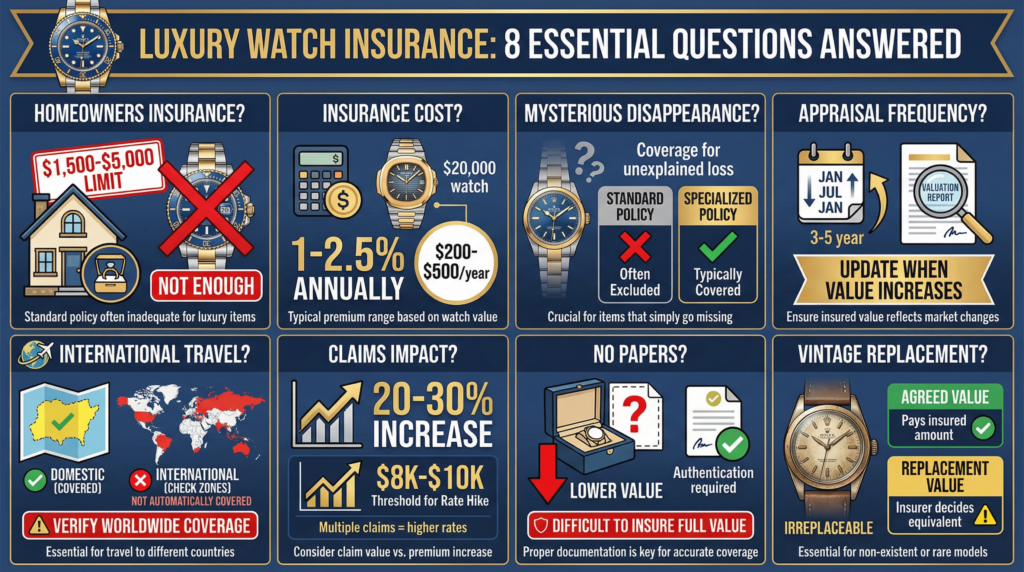
Homeowners insurance typically includes jewelry coverage up to $1,500 to $5,000 total, which is completely inadequate for a Rolex. You can add scheduled personal property coverage to specifically list your Rolex with its appraised value, but this coverage still inherits the limitations of your homeowners policy including potential exclusions for mysterious disappearance.
How much does it cost to insure a $20,000 watch?
Specialized watch insurance typically costs 1% to 2.5% of the watch’s appraised value annually. For a $20,000 watch, expect premiums between $200 and $500 per year depending on the insurer, your location, security measures in place, and your claims history.
What does mysterious disappearance coverage mean?
Mysterious disappearance coverage protects you when your watch vanishes without clear explanation of how it was lost or stolen. Standard policies often exclude this, meaning if you can’t prove exactly how your watch disappeared, they won’t pay the claim.
This represents one of the most common loss scenarios for watches.
Do I need a new appraisal every year for watch insurance?
Most insurers require appraisals every three to five years, but you should get new appraisals whenever significant market movements occur. If your watch appreciates substantially because of discontinuation or market trends, failing to update your appraisal leaves you underinsured and you’ll only recover the outdated value during a claim.
Does watch insurance cover international travel?
Only if your policy specifically includes worldwide coverage. Many standard policies limit coverage to domestic territory only, leaving you completely unprotected when traveling internationally.
Always verify geographic coverage limits before traveling with valuable watches.
Will filing a watch insurance claim increase my premiums?
Yes, filing claims typically increases premiums by 20% to 30% at renewal, and multiple claims within three years can price you out of preferred coverage entirely. Many collectors choose not to file claims under $8,000 to $10,000 to maintain clean claims history and lower premiums long-term.
Can I insure a watch without original papers?
You can insure watches without original papers, but you’ll need a professional appraisal that authenticates the watch and establishes its value. Watches without papers typically receive lower appraisals than complete sets, which means lower coverage amounts and potentially higher premiums because of authentication concerns.
What happens if my vintage watch can’t be replaced?
With agreed value coverage, the insurer pays the insured amount regardless of whether the watch can be replaced. With replacement value coverage, the insurer offers what they decide is equivalent, which often leads to disputes for irreplaceable vintage pieces. This is why agreed value coverage is essential for vintage and discontinued references.